

JST XH vs. JST PH: Which Connector Should You Choose?
Choosing the wrong JST connector can cause mating failure, bent PCB pins, loose contacts, overheating, or an expensive board redesign.
The safest solution is to identify the exact series by pitch, housing dimensions, terminal part number, wire range, and published electrical rating. JST XH and JST PH are both single-row wire-to-board connector families, but they are not interchangeable.
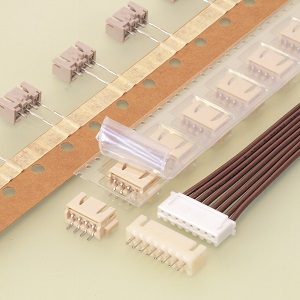
JST XH Series
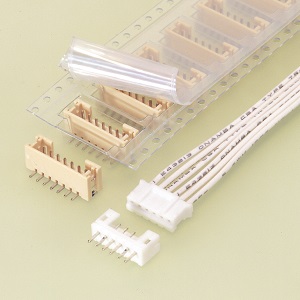
JST PH Series
What Is the Main Difference Between JST XH and JST PH?
Judging these connectors only by color or pin count can result in ordering a housing that cannot mate with the PCB header.
Measure the center-to-center pin spacing first: JST XH uses a 2.50 mm pitch, while JST PH uses a 2.00 mm pitch. The 0.50 mm difference changes the housing width, terminal geometry, PCB footprint, and compatible crimp components.
| Specification | JST XH Series | JST PH Series | Selection Impact |
|---|---|---|---|
| Pitch | 2.50 mm | 2.00 mm | The housings and headers cannot mate |
| Published current rating | 3 A AC/DC with AWG 22 | 2 A AC/DC with AWG 24 | XH supports a larger published wire and current rating |
| Voltage rating | 250 V AC/DC | 100 V AC/DC | The product rating must match the complete application |
| Conductor range | AWG 30 to AWG 22 | AWG 32 to AWG 24 | Each series requires its own terminal and insulation range |
| Top-entry mounting height | 9.8 mm | 8.0 mm | PH saves space in compact equipment |
| Temperature range | -25°C to +85°C | -40°C to +105°C | Verify the exact part and operating environment |
JST lists XH as a 2.50 mm pitch connector rated at 3 A with AWG 22 wire and 250 V AC/DC. PH is listed as a 2.00 mm pitch, low-profile connector rated at 2 A with AWG 24 wire and 100 V AC/DC.[1][2]
Which Connector Is Better for Your PCB and Current Load?
Selecting PH only because it is smaller can create excessive temperature rise, while choosing XH without checking space can cause enclosure interference or PCB-layout failure.
Choose XH when the design needs a larger wire range, higher published current rating, or a more generous mechanical footprint; choose PH when board density and low profile are the main constraints. The final choice must include current, wire size, ambient temperature, circuit count, contact resistance, and available mating space.
The catalog current value is not a universal safe current for every harness. JST states the XH rating with AWG 22 and the PH rating with AWG 24. Smaller conductors, high ambient temperature, bundled wires, poor crimps, contamination, and repeated vibration can reduce practical current capability.
The connector voltage rating also does not automatically approve the finished product for that voltage. PCB spacing, pollution level, insulation condition, wire rating, terminal installation, and applicable safety requirements must be reviewed as one system.
Neither series should be selected for a harsh vehicle location only because the current and voltage numbers appear acceptable. Both use friction-lock mating. Automotive vibration, water exposure, chemicals, connector position assurance, sealing, and customer-specific validation may require a dedicated automotive connector system.
How Can You Avoid Identification and Crimping Failures?
Using an incorrect housing, imitation terminal, generic hand tool, or uncontrolled crimp can cause terminal back-out, conductor breakage, high resistance, and intermittent field failures.
Confirm the complete JST part-number chain and use the terminal, housing, header, wire, strip length, and crimp tooling specified for that series. Inspect conductor crimp, insulation support, terminal locking, insertion depth, and pull strength before releasing production.
To identify an unknown connector, measure pitch between pin centers rather than across the outside edges. Check the number of positions, mating direction, housing key, friction-lock features, wire diameter, and PCB-header geometry.
Do not automatically call a 2.54 mm header “JST XH.” XH is officially 2.50 mm. A two-position connection may appear to align with a 0.1-inch header, but the 0.04 mm difference accumulates across longer connectors. Across six positions, the outside pin-center mismatch reaches approximately 0.20 mm.
IPC/WHMA-A-620 provides industry acceptance requirements for crimped, mechanically secured, and soldered cable and wire-harness interconnections. Production control should include calibrated tooling, crimp-height verification where specified, pull testing, visual inspection, and electrical continuity testing.[3]
Send your connector series, circuit count, wire gauge, cable length, pinout, current, operating temperature, drawing, and annual quantity for a manufacturability review or prototype evaluation.
FAQ
Assuming that all small white connectors are interchangeable can cause incorrect purchasing, damaged headers, reversed polarity, and failed equipment.
Use the following answers to verify the connector family before ordering housings, terminals, headers, or finished cable assemblies.
Are JST XH and JST PH connectors compatible?
No. JST XH has a 2.50 mm pitch, while JST PH has a 2.00 mm pitch. Their housings, terminals, and PCB headers are different.
Can JST XH mate with a 2.54 mm header?
It may appear to fit at low pin counts, but it is not the official XH pitch. The dimensional mismatch increases with each additional position and can stress the housing or pins.
Can JST PH carry 3 amps?
JST publishes a 2 A rating for PH with AWG 24 wire. Do not increase the load without manufacturer guidance and validation of temperature rise, wire size, crimp quality, and operating conditions.
Do JST XH and PH use the same crimping tool?
No. The series use different terminals and crimp dimensions. Use tooling approved for the exact terminal part number rather than a generic plier.
Which is smaller, JST XH or JST PH?
JST PH is smaller. It uses a 2.00 mm pitch and has an 8.0 mm top-entry mounting height, compared with the 2.50 mm pitch and 9.8 mm height of JST XH.
Final Expert Recommendation
Based on 15 years of automotive wire harness experience, I recommend selecting JST XH or PH as a complete connection system rather than choosing only by pitch or price. The housing, header, terminal, conductor size, insulation diameter, crimp tooling, current load, retention, and operating environment must work together.
For a connector identification review, custom cable sample, pinout check, or production feasibility assessment, provide clear connector photos, measured pitch, PCB-header dimensions, wire specifications, and electrical requirements before placing the order.
Authoritative References
[1]J.S.T. Mfg. Co., Ltd. — XH Connector Official Specifications
[2]J.S.T. Mfg. Co., Ltd. — PH Connector Official Specifications
[3]Global Electronics Association — IPC/WHMA-A-620 Cable and Wire Harness Requirements


