
What Do Car Stereo Wire Color Codes Mean?
Connecting the wrong stereo wire can erase radio presets, drain the battery, disable speakers, blow a fuse, or damage the head unit.
The safest solution is to use the aftermarket radio diagram and verify every vehicle-side circuit before making a connection.
Common aftermarket harnesses often use yellow for constant power, red for accessory power, black for ground, and white, gray, green, and purple pairs for speakers.
Yellow: Constant 12V power
Red: Accessory or ignition power
Black: Ground
Blue: Power antenna
Blue/White: Amplifier remote
Orange/White: Illumination or dimmer
White, Gray, Green, and Purple: Speaker pairs
Important: These are common aftermarket head-unit colors, not universal factory vehicle wire colors. Original wiring varies by vehicle make, model, year, trim level, and audio system.
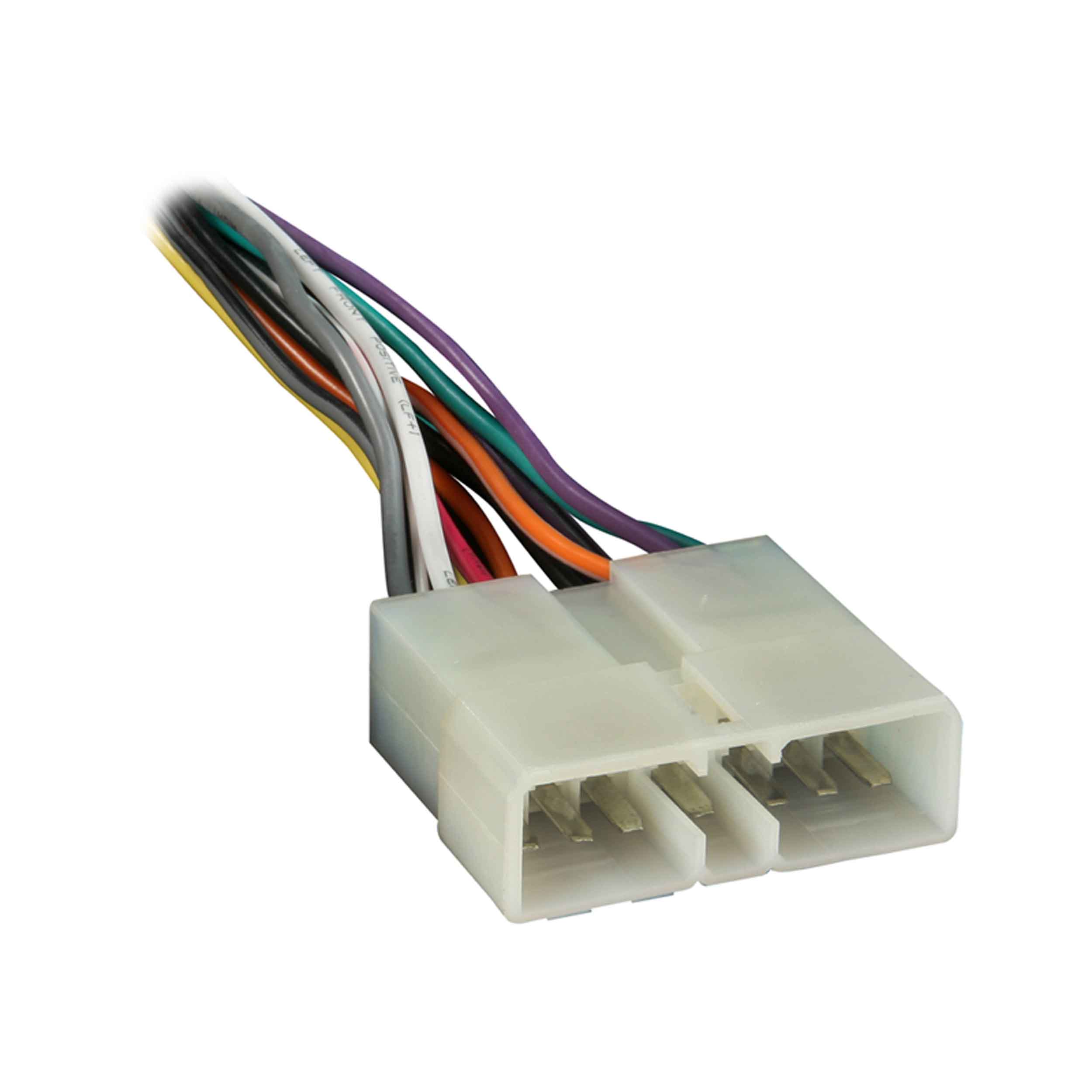
Metra Electronics
.[3]
What Do Red, Yellow, Black, and Blue Stereo Wires Do?
Mixing constant power, accessory power, ground, and remote-control wires can cause lost settings, battery drain, amplifier failure, or immediate fuse damage.
The correct solution is to identify each circuit by function and confirm it with the head-unit manual and a multimeter.
Sony and Kenwood wiring documentation uses the following common aftermarket functions, although individual models may differ.[1][2]
| Common Wire Color | Typical Function | What Can Go Wrong? |
|---|---|---|
| Yellow | Constant 12V battery power | Clock and presets reset when power is missing |
| Red | Switched accessory or ignition power | Radio stays on or fails to turn on |
| Black | Ground connection | Noise, unstable operation, or no power |
| Blue | Power antenna control | Antenna does not extend or amplifier switches off |
| Blue/White | Amplifier remote turn-on | External amplifier produces no sound |
| Orange or Orange/White | Illumination or dimmer input | Display brightness works incorrectly |
| Light Green | Parking-brake detection input | Safety functions or video controls do not operate |
| Purple/White | Reverse-gear signal | Backup-camera view does not activate |
The light-green parking-brake wire should be connected to the vehicle’s parking-brake detection circuit exactly as specified by the radio manufacturer. Do not permanently ground or bypass the safety interlock.
Some modern vehicles do not provide a conventional switched 12V accessory wire behind the factory radio. A vehicle-specific data interface may be required to provide accessory power, illumination, reverse, parking-brake, speed-sense, steering-wheel-control, or factory-chime functions.[4]
How Are Car Stereo Speaker Wire Colors Paired?
Reversing speaker polarity can weaken bass and stereo imaging, while grounding a speaker output to the vehicle body can damage the radio amplifier.
The solution is to keep every positive and negative speaker wire connected as a dedicated pair.
Many aftermarket radios use a solid color for positive and the same color with a black stripe for negative.
| Speaker Location | Positive Wire | Negative Wire |
|---|---|---|
| Front Left | White | White/Black |
| Front Right | Gray | Gray/Black |
| Rear Left | Green | Green/Black |
| Rear Right | Purple | Purple/Black |
Never connect the negative speaker wires together or attach them to chassis ground unless the manufacturer specifically requires it.
Modern bridge-tied-load head units normally require isolated positive and negative outputs for each speaker.
Why Does a Car Stereo Lose Memory, Have No Sound, or Create Noise?
Blindly swapping wires can turn a simple installation problem into a blown fuse, drained battery, damaged speaker output, or failed vehicle module.
The correct solution is to diagnose the circuit before changing any connection.
Check the head-unit fuse, vehicle fuse, constant voltage, switched voltage, ground resistance, speaker isolation, remote output, and connector retention in a controlled sequence.
| Symptom | Likely Cause | Correct Check |
|---|---|---|
| Radio will not turn on | Missing ACC, constant power, ground, or blown fuse | Measure red, yellow, and black circuits with a multimeter |
| Clock and presets reset | Yellow wire is not receiving constant 12V | Confirm constant voltage with the ignition off |
| No speaker sound | Shorted speaker wire, factory amplifier, or missing remote signal | Test speaker pairs and the blue/white remote output |
| Engine or alternator noise | Poor ground, ground loop, or incorrect signal-cable routing | Inspect grounding and separate signal cables from power wiring |
| Amplifier will not switch on | Blue antenna wire used instead of blue/white remote wire | Verify remote voltage when the radio is operating |
Do not automatically swap the red and yellow wires when the radio loses its settings.
First measure the vehicle-side circuits, then correct the connection according to the radio manual and vehicle-specific adapter diagram.
Send your radio model, vehicle connector, circuit list, cable length, terminal requirements, and annual demand for a drawing review or prototype sample.
FAQ
Assuming every vehicle uses the same colors can damage the radio or factory electronics.
Use these answers as an aftermarket reference, then confirm the exact vehicle and head-unit diagrams.
What color wire provides constant 12V power?
Yellow commonly provides constant 12V power for the radio memory and clock.
What color wire turns an aftermarket stereo on?
Red commonly connects to switched accessory or ignition power.
What is the blue and white wire on a car stereo?
Blue/white commonly provides the remote turn-on signal for an external amplifier.
Are factory car stereo wire colors universal?
No. Factory colors vary by vehicle manufacturer, model, production year, trim level, and audio system.
Why does my car stereo lose its presets?
The constant 12V memory circuit may be missing, incorrectly connected, or losing voltage when the ignition is switched off.
Based on 15 years of automotive wire harness experience, I never approve a stereo connection from color alone. The safest installation verifies the radio diagram, vehicle circuit, connector pin, voltage, polarity, and terminal retention before power is applied.
Authoritative References
[1]
Sony — Wire Colors and Functions for a 16-Pin Car Stereo Harness
[2]
Kenwood — Head-Unit Wiring, Parking-Brake, Reverse, and Speaker Connections
[3]
Metra Electronics — Color-Coded Radio Replacement Harness
[4]
Metra Electronics — Vehicle Data Interface with Accessory, Reverse, and Parking-Brake Outputs


